


Meeting Francis Again, Through Carlo Carretto – Dr. Fr. Conrad Pesso, SJ
Meeting Francis Again, Through Carlo Carretto
By Dr. Fr. Conrad Pesso, SJ
Around fifty years ago, during a period of searching for my own path forward, my sister Svetlana gave me a copy of Carlo Carretto’s Letters from the Desert. At the time, my reading list fluctuated between George Orwell, Somerset Maugham, and St Thérèse of Lisieux, alongside books on law and finance. Yet it was Carretto’s words that gripped me. I returned to that book more than twenty times, finding myself renewed and deeply moved with every reading.
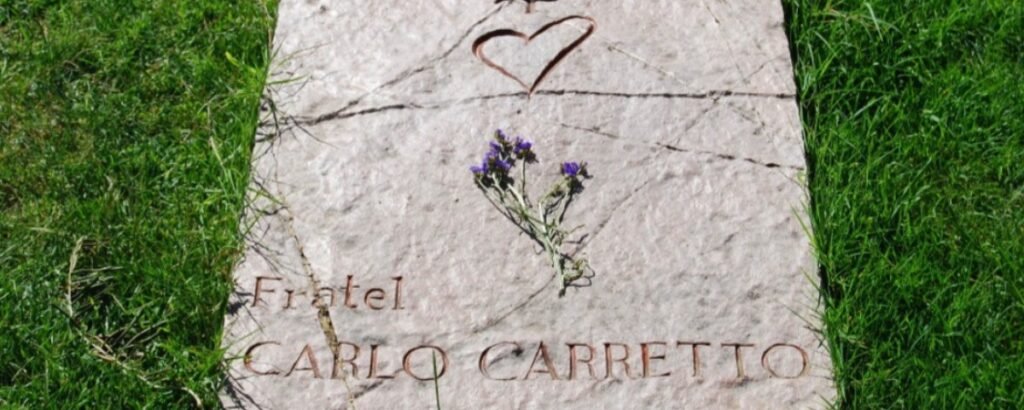
That initial encounter sparked a lifelong engagement. I collected every book Carretto ever wrote and closely followed the footprint of his community in India. Decades later, that fifty-year journey came full circle. While visiting Assisi with Svetlana and her family, we moved from a meditative time with St Francis to visit Carretto’s own final resting place in Spello, nestled in the Umbrian landscape. It was a deeply moving pilgrimage to the grave of a man who lived as a devoted follower of Francis and passed into eternity on the saint’s feast day, 4 October 1988.
Why bring you to this intersection of my personal journey and these two spiritual giants?
As we celebrate the 800th anniversary of the enduring wonder that is Francis of Assisi, I want to invite readers here in India to encounter him in a contemporary mould. To do so, no one serves as a better bridge than the mystic Carlo Carretto.
In his fictionalised autobiography I, Francis, Carretto boldly adopts the first-person voice of the saint, instantly dismantling the romanticised caricature of a man who merely talks to birds. He presents Francis not as a medieval curiosity, but as a disruptive, living prophet whose radical embrace of the Gospel serves as a direct indictment of modern greed, urban consumerism, and spiritual complacency.
I offer you these reflections and excerpts from this profound work, hoping they will prompt you to read the book itself and, through it, to better appreciate the true spirit of St Francis.
The Interior Desert: Radical Poverty and Naked Faith
In the book, Carretto’s Francis insists that poverty was never merely a lifestyle choice or an exercise in philanthropy. As the saint reflects, “Poverty did not consist in helping the poor; it consisted in being poor.” It was a necessary stripping away of the human ego in order to encounter God in absolute vulnerability.
Carretto writes through the voice of Francis: “Poverty is not just a lack of things; it is a lack of self. It is the vacuum into which God can pour His love.”
External lack is merely the beginning, for “true poverty went to the bottom of things, and touched the spirit.” This perspective resonates deeply with the spiritual heritage of India, beautifully mirroring the ancient concept of aparigraha (non-possession) and the ascetic path of the sannyasi.
Francis notes that “putting a little money aside, keeping a larder, buying a house” would have meant a devastating “lack of trust in my Lord.” True spiritual wealth begins when physical ownership ends, shifting the soul from the “eros of easy things” to the profound “agape of heroes of the spirit.”
Crucially, this path is not presented as a platform for social activism or systemic restructuring. Francis clarifies that his “choice to be poor, then, was not a social or political choice, but a mystical one.” He did not set out to organise a political pressure group or engage in a conventional class struggle. He recognised that while revolutions fight for the working classes, “nothing changed, because these people did not change hearts.”
For him, the Gospel was a call to look beyond temporal structures: “It is not enough to change laws. You have to change hearts.”
For a reader navigating the hyper-materialistic, upwardly mobile realities of modern megacities such as Mumbai or Bengaluru, Carretto’s Francis offers a sharp wake-up call to look beyond “a life of easy pleasure.” He models a journey that transcends human constructs, civilisations, and conventions, reminding us that true liberation is found not in what we accumulate, but in what we have the courage to discard.
The Armour of Peace: Non-Violence and Unarmed Love
Just as Francis’s radical poverty was a mystical surrender rather than a political statement, his response to a violent world bypassed the conventional logic of warfare and strategic defence.
For a modern reader grappling with global strife or systemic conflict, Carretto’s Francis offers a timeless pattern of deep, active non-violence. He did not wage war for justice, even when the suffering of the poor seemed to demand it. Instead, he introduced a method of confronting injustice that relied on entirely different weapons: humility, presence, and unarmed love.
By stepping out onto the open road without a script or a shield, Francis showed that the only way to break the cycle of human violence is to absorb it rather than reflect it back. In a world defined by division, his life remains a radical blueprint for peace built from the inside out.
Rebuilding from Within: A Quiet Meditation on a Broken, Beloved Church
For Carretto, this deep interior stripping—this radical detachment from worldly constructs—was never meant to drive the believer away from the community. It was designed to anchor the believer more deeply within it, even when that community is terribly flawed.
The absolute vulnerability born in the desert of poverty becomes the precise tool needed to face the institutional Church.
“Repair it.”
When the Lord spoke these words to Francis from the crucifix at San Damiano, Francis first looked at the crumbling stone walls around him. It takes time for human hearts to understand the vastness of God’s designs. Francis soon realised that the call was not merely to rebuild a small, quiet refuge, but to help restore the great Church stretching across the earth—the one founded by Jesus himself, who at San Damiano had spoken to Francis, telling him directly: “Repair it.”
For more than two thousand years, the gates of hell have targeted the Church, yet they have not prevailed. Anyone who deeply loves the Church today, however, knows the heavy grief of looking at its wounds, its power dynamics, and the burden of “shameless wealth” and “involvement with power politics.” And yet, like Francis, we are called to stay, to love, and to labour with an enduring, quiet hope.
Writing with the hindsight of eight centuries, Carretto’s Francis does not ignore the historical corruption or wealth of the ecclesiastical hierarchy. He speaks of having “seen no poverty in the halls of the Vatican.” Yet instead of advocating for schism or walking away in bitter anger, Francis models an agonising, fierce loyalty.
He recognises a profound debt, asking us directly: “Who would have handed down to us, across twenty centuries, the teachings of our dear Lord Jesus? Who would have encouraged us in the truth, reassured us in the path we had undertaken?”
This is the great mystery we live with: the Church is simultaneously holy and broken, divine and deeply human—“at once indefectible by divine promise, and capable of scandalizing… by its riches and its might.”
When confronted with the flaws of our spiritual home, it is incredibly easy to become bitter, sour, and judgmental, quick to point an accusing finger at the festering sores of others.
But Francis heard a softer voice whisper in his spirit: “Judge not… I have come not to judge but to save.”
He realised that if he wanted to have any right to speak, he must have compassion. If we wish to heal the Church today, we must begin where Francis began: not with criticism, but with compassion.
We reform the Body of Christ by allowing Christ to reform us, becoming simple instruments of grace from within the very home He built for us.
It is here, in this tension, that we find the most poignant prayer of the modern pilgrim, reflecting Carretto’s own deep theological struggles as a monk addressing the Church directly:
Perhaps this is the enduring invitation of Carlo Carretto’s I, Francis: to encounter Francis not as a distant figure of history, but as a living challenge to our way of seeing, possessing, loving, and believing.
Francis calls us beyond easy answers—to poverty that frees, peace that does not depend on violence, and a love for the Church that remains faithful even in the face of its wounds.
And perhaps, in meeting Francis again through Carretto, we may also discover something of the Francis who is still waiting to be encountered in our own time.
Discover I, Francis by Carlo Carretto
Dr. Fr. Conrad Pesso, SJ, invites us to encounter St Francis anew through Carlo Carretto’s powerful fictionalized autobiography.
Read the book and enter more deeply into the spirit of St Francis.
Shop Now: Pauline India